Sake: How Many ML in One Go? Calories, Serving Size & Drinking Guide
You order "ichi-go" of sake, but what does that really mean? Beyond a measure, it's steeped in tradition. We'll explore its volume, calories, and how to best enjoy it.

よつば
May 2, 2026

You might order "one *go* (一合) of Japanese sake" at an *izakaya* (居酒屋, Japanese pub), but do you know exactly how many milliliters that is? Japanese sake (日本酒) has traditionally been measured using unique Japanese units like *go* (合), *sho* (升), and *to* (斗). This article will explain everything from the precise volume of one *go* of sake to its calories, alcohol content, recommended serving size, and tips for enjoying it.
One *Go* of Japanese Sake is Approximately 180ml
 Photo by Vinny Anugraha on Pexels
One *go* of Japanese sake is approximately 180ml. More precisely, it's 180.39ml, but it is generally treated as 180ml.
The *go* is an ancient Japanese unit from the *shakkan-ho* (尺貫法) system, which has been used since ancient times as a unit of volume, alongside units of length like *shaku* (尺) and *sun* (寸), and units of weight like *kan* (貫) and *kin* (斤). It was formally defined by the Weights and Measures Act during the Meiji era and is still used today to measure Japanese sake and rice.
Capacity of a One-*Go* *Tokkuri* and a One-*Go* *Masu*
A one-*go* *tokkuri* (徳利), a sake carafe served at *izakaya* and other establishments, holds approximately 180ml of Japanese sake. When drinking Japanese sake from a wooden *masu* (枡), a one-*go* *masu* also holds approximately 180ml.
Note that there are *tokkuri* labeled "Sei Ichigo" (正一合, precisely one *go*) and those that hold approximately 180ml as a guideline. Sei Ichigo *tokkuri* are precisely calibrated to 180ml and are used for bulk sales and accurate measurement.
Comparison with Other Volumes
Comparing the volume of one *go* to common containers, it's slightly less than a 200ml milk carton and about a quarter of a full bottle of wine (750ml). Compared to a 350ml can of beer, it's about half the amount.
Calories and Alcohol Content of One *Go* of Japanese Sake
 Photo by
 For those concerned about health, the calories and alcohol content per *go* are important information.
Calories per *Go*: Approximately 190kcal
The calorie content of one *go* (180ml) of Japanese sake ranges from approximately 190kcal to 200kcal. This is slightly less than a bowl of rice (150g, approx. 240kcal) and slightly more than a 350ml can of beer (approx. 140kcal).
However, since Japanese sake contains carbohydrates, it's important to pay attention not only to calories but also to carbohydrate content. The carbohydrate content per *go* is approximately 8g, which is similar to a large can of beer (500ml).
Alcohol Content per *Go*: Approximately 22g
The alcohol by volume (ABV) of Japanese sake is generally around 15%. The alcohol content per *go* (180ml) is calculated as 180ml × 0.15 × 0.8 (specific gravity of alcohol), resulting in approximately 21.6g, or about 22g.
When compared by pure alcohol content, one *go* of Japanese sake is equivalent to about 1.5 cans of beer (5% ABV, 350ml), or about 1.5 glasses of wine (12% ABV, 120ml per glass).
Japanese Sake Units: The Relationship Between *Go*, *Sho*, and *To*
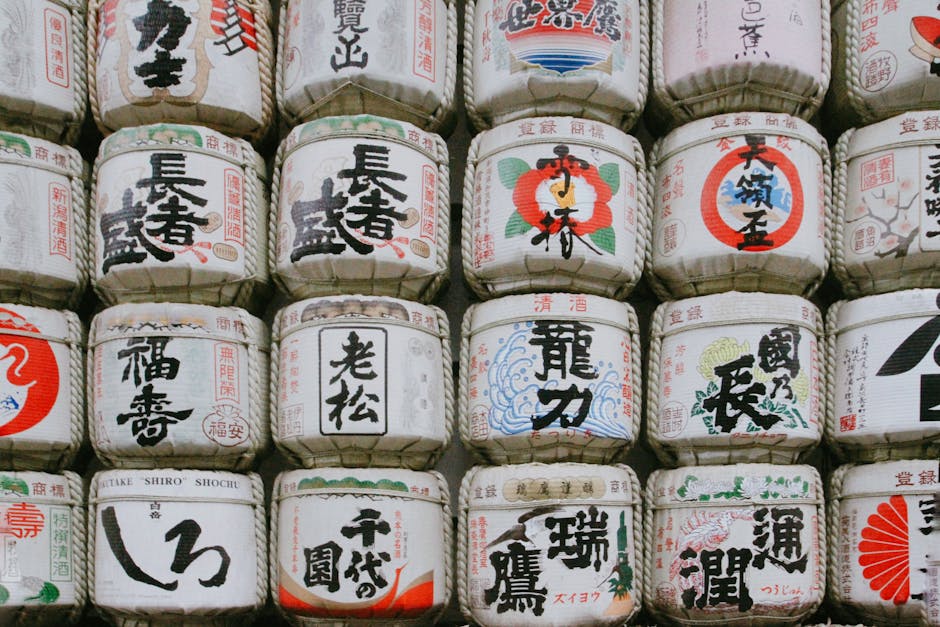 Photo by
 When organizing the *shakkan-ho* units used for Japanese sake, the relationships are as follows:
One *shaku* (一勺) is approximately 18ml, which is one-tenth of a *go*. One *go* is approximately 180ml. One *sho* (一升) is 1,800ml, which is ten times a *go*. One *to* (一斗) is 18,000ml, which is ten times a *sho*. As an even larger unit, one *koku* (一石) is 180,000ml, which is ten times a *to*.
An *issho-bin* (一升瓶), commonly seen at *izakaya*, refers to a 1,800ml bottle. A *yongo-bin* (四合瓶) refers to a 720ml bottle. A *yongo-bin* is slightly smaller than half an *issho-bin* and is a popular size for home consumption.
Two-*Go* and Three-*Go* Designations Also Exist
Multiples of a *go*, such as two *go* (approximately 360ml) and three *go* (approximately 540ml), are also used as ordering units for Japanese sake. Larger *tokkuri*, known as two-*go* *tokkuri* and three-*go* *tokkuri*, are also available and convenient for groups enjoying Japanese sake.
Recommended Daily Intake of Japanese Sake
 Photo by
 To enjoy Japanese sake healthily, it's important to know the appropriate amount.
Recommended Amount by the Ministry of Health, Labour and Welfare
Japan's Ministry of Health, Labour and Welfare's "Healthy Japan 21" initiative suggests an approximate daily pure alcohol intake of about 20g for moderate drinking. When converted to Japanese sake, this is equivalent to exactly one *go* (180ml).
However, this is merely a general guideline, and women, the elderly, and individuals with smaller physiques are recommended to consume even less. Furthermore, those with a low tolerance for alcohol should adjust their intake according to their own physical condition.
Be Mindful of Your Drinking Pace
It is recommended to savor one *go* slowly rather than drinking it all at once. While alcohol decomposition varies by individual, it is generally said that it takes approximately 3 hours for an adult male weighing 60kg to metabolize the alcohol from one *go*.
Having at least two alcohol-free days per week is also recommended as a healthy drinking habit.
Tips for Deliciously Enjoying One *Go* of Japanese Sake
 Photo by Matthew Jesús on Pexels
To maximize your enjoyment of the appropriate one-*go* serving, you'll want to pay attention to how you drink it.
Flavor Changes Depending on Serving Temperature
Japanese sake is an alcoholic beverage whose character changes significantly with temperature. Chilled sake, or *reishu* (冷酒), served at 5 to 10 degrees Celsius, offers a crisp and refreshing taste. Sake served at room temperature, or *hiya* (冷や), typically around 15 degrees Celsius, brings out the umami of the rice. Warm sake, or *nurukan* (ぬる燗), around 40 degrees Celsius, allows its aroma to rise. Hot sake, or *atsukan* (熱燗), around 50 degrees Celsius, enhances its richness and sweetness.
If you try one *go* at several different temperatures, you can enjoy completely different flavors from the same sake.
Recommended Sake Vessels
For *reishu*, small *choko* (猪口, sake cups) or wine glasses are suitable. For warm sake, the classic combination is a *tokkuri* and *choko*. Tin sake vessels are said to make the sake taste smoother and are popular as gifts.
Pairing with Food
If you're enjoying one *go* slowly, consider its compatibility with food. Light and dry Japanese sake, or *tanrei karakuchi* (淡麗辛口), pairs well with sashimi and salt-grilled fish. Rich and full-bodied Japanese sake, or *nojun* (濃醇), is an excellent match for simmered dishes and strongly flavored cuisine.
Summary
 Photo by Pat Saengcharoen on Pexels
One *go* of Japanese sake is approximately 180ml, with about 190kcal and 22g of alcohol. This amount corresponds precisely to the recommended daily intake suggested by the Ministry of Health, Labour and Welfare, making one *go* a good guideline to savor slowly for healthy enjoyment.
Understanding *shakkan-ho* units like *go*, *sho*, and *to* can be helpful when ordering at an *izakaya* or purchasing *yongo-bin* and *issho-bin*. Experiment with different serving temperatures, sake vessels, and food pairings to fully enjoy your one *go* of Japanese sake.
Frequently Asked Questions
Q日本酒の一合は何mlですか?具体的な量と単位について教えてください。
日本酒の一合は約180mlです。正確には180.39mlですが、一般的に180mlとして扱われます。これは尺貫法という日本古来の容量単位で、居酒屋の一合徳利や一合枡にも約180mlの日本酒が入ります。200mlの牛乳パックよりやや少ない量です。
Q日本酒一合のカロリーとアルコール量はどれくらいですか?
日本酒一合(180ml)のカロリーは約190kcalから200kcalで、ご飯一膳よりやや少なく、缶ビール350mlよりやや多いです。糖質は約8g。アルコール度数15%前後の場合、純アルコール量は約22gとなり、缶ビール350ml約1.5本分に相当します。
Q日本酒の1日の適量はどのくらいですか?健康的な飲み方を教えてください。
厚生労働省「健康日本21」によると、1日あたりの純アルコール量約20g程度が節度ある適度な飲酒の目安です。これを日本酒に換算すると、一合(180ml)程度に相当します。女性や高齢者、体格の小さい方はさらに少なめが推奨され、ゆっくり味わい、週に2日以上の休肝日を設けることが大切です。
Q日本酒の「合」「升」「斗」といった単位の関係を教えてください。
日本酒に使われる尺貫法の単位は、一勺が約18ml、一合が約180mlです。一升は1,800mlで一合の10倍、一斗は18,000mlで一升の10倍にあたります。さらに一石は180,000mlです。居酒屋でよく見る一升瓶は1,800ml、四合瓶は720mlを指します。


