Muroka Nama Genshu: Definition, Flavor Profile, and How It Differs from Other Sake
Ever seen "Muroka Nama Genshu" on sake labels? This least-processed, natural sake is gaining popularity. Learn its definition, taste, and how to enjoy it here.

よつば
May 6, 2026
Have you ever seen the long name "Muroka Nama Genshu (無濾過生原酒)" on a Japanese sake (日本酒) label? This type of sake, which is the most minimally processed and closest to its natural state among all Japanese sake, has been gaining popularity in recent years. This article will explain Muroka Nama Genshu in detail, from its definition and flavor characteristics to how it differs from other types of sake and recommended ways to enjoy it.
Definition of Muroka Nama Genshu
 Photo by Matthew Jesús on Pexels
Muroka Nama Genshu refers to Japanese sake that skips all three processes of filtration (濾過), pasteurization (火入れ), and dilution (加水).
Regular Japanese sake is typically filtered with activated charcoal after pressing, pasteurized (火入れ) for quality stabilization, and diluted with water to adjust the alcohol content before shipping. Muroka Nama Genshu, which undergoes none of these processes, can be said to be the closest to its freshly pressed state and the most minimally processed Japanese sake.
The Significance of Skipping These Three Processes
By skipping filtration (濾過), the sake retains its original color (a faint golden hue) and complex flavor components. By skipping pasteurization (火入れ), enzymes and yeasts remain active when shipped, allowing for a fresh aroma and taste. By not diluting (加水), the alcohol content is higher, resulting in a rich flavor with concentrated rice umami.
The combination of these three omissions gives Muroka Nama Genshu a unique presence unmatched by any other Japanese sake.
Flavor Characteristics of Muroka Nama Genshu
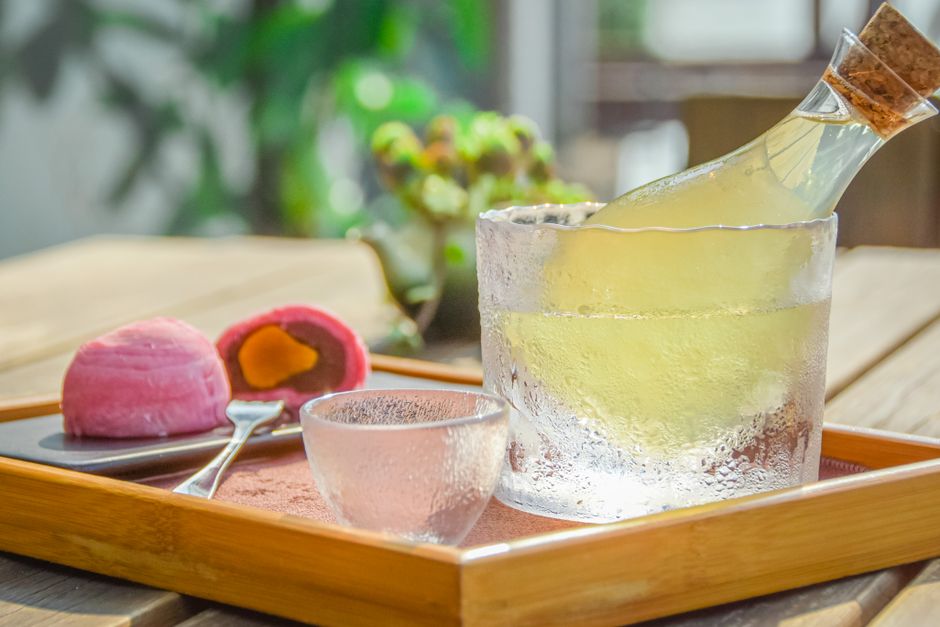 Photo by
 Muroka Nama Genshu is a type of Japanese sake that offers a particularly distinctive flavor profile.
Concentrated Rice Umami
Because it is undiluted, it has a rich flavor with concentrated rice umami, sweetness, and koji (rice mold) aroma. Its appeal lies in the profound richness that fills your mouth with complex rice-derived flavors from just one sip.
Fresh Effervescence
As it is nama-zake (生酒), which has not been pasteurized, fine carbon dioxide gas from fermentation may remain in the bottle. When you taste it, you might experience a crisp, refreshing sensation, characteristic of freshly pressed Japanese sake.
Golden Hue
Because it is unfiltered, its color is not clear but a faint golden hue. This color itself is proof that the rice flavor components remain, making it a unique characteristic of muroka-shu (無濾過酒).
High Alcohol Content
As it is genshu (原酒), which is undiluted, its alcohol content is relatively high, typically 17-20%. Even a small amount offers a substantial drinking experience, providing a satisfying buzz and sense of fulfillment.
Differences Between Muroka Nama Genshu and Other Japanese Sake
 Photo by
 Let's clarify how Muroka Nama Genshu differs from other categories such as "Muroka" (unfiltered), "Nama" (unpasteurized), and "Genshu" (undiluted).
Differences from Muroka-shu
Muroka-shu (無濾過酒) is Japanese sake where only filtration is omitted, with pasteurization and dilution performed as usual. Its color and richness of flavor are similar to Muroka Nama Genshu, but it has better shelf stability and an alcohol content of around 15-16%.
Differences from Nama-zake
Nama-zake (生酒) is Japanese sake where only pasteurization is omitted, with filtration and dilution performed as usual. Its fresh taste is similar to Muroka Nama Genshu, but its color is clear, and its alcohol content is standard.
Differences from Genshu
Genshu (原酒) is Japanese sake where only dilution is omitted, with filtration and pasteurization performed as usual. Its high alcohol content and concentrated rice umami are similar to Muroka Nama Genshu, but its color is clear, and it has better shelf stability.
Muroka Nama Genshu Possesses All Three Characteristics
Muroka Nama Genshu is, so to speak, the "ultimate" Japanese sake, possessing the rich flavor of muroka-shu, the freshness of nama-zake, and the intensity of genshu. It can be said to be a bottle that allows you to experience the maximum appeal of Japanese sake.
How to Store Muroka Nama Genshu
 Photo by
 Muroka Nama Genshu is a very delicate sake and requires extreme care in storage.
Always Refrigerate
Because it is unpasteurized, its flavor will change rapidly due to enzyme and yeast activity if left at room temperature. The iron rule is to store it immediately in a refrigerator at 5 degrees Celsius (41°F) or below after purchase.
Consume Promptly After Opening
After opening, oxidation progresses with exposure to air, and the freshness unique to nama-zake is lost. Ideally, we recommend finishing it within 3 days to a week, or at the latest, within two weeks.
It's a wise choice to purchase it in easy-to-finish sizes, such as a yon-go-bin (四合瓶, 720ml bottle) or a 300ml small bottle.
Store Upright
Store the bottle upright in a place with minimal temperature fluctuation, such as the back of the refrigerator or the vegetable crisper. Storing it horizontally can cause the cork/cap to be in prolonged contact with the liquid, potentially leading to quality degradation.
Delicious Ways to Enjoy Muroka Nama Genshu
 Photo by Miguel González on Pexels
To fully enjoy the rich flavor and freshness of Muroka Nama Genshu, there are a few tips for drinking it.
Serve Well Chilled
Chilling it thoroughly to 5-10 degrees Celsius (41-50°F) tightens the balance between its fresh aroma and rich flavor. It's even more refreshing if you chill your glass or choko (猪口, sake cup) right after taking it out of the refrigerator.
Enjoy the Aroma in a Wine Glass
Drinking it from a wide-mouthed wine glass allows the complex aromas of Muroka Nama Genshu to rise, letting you fully appreciate its delicate flavors. The aroma spreads more richly than in a typical choko.
On the Rocks, Slowly
Due to its high alcohol content, it can also be enjoyed deliciously on the rocks. A characteristic feature is that the flavor changes as the ice melts, allowing for prolonged enjoyment.
Refreshing with Soda
The rich Muroka Nama Genshu retains its flavor even when mixed with soda. Mixing it in a 1:1 to 1:2 ratio creates a refreshing, highball-style Japanese sake.
Dishes that Pair Well with Muroka Nama Genshu
 Photo by DUONG QUÁCH on Pexels
Choosing robust dishes that can stand up to the rich flavor of Muroka Nama Genshu will result in excellent pairings.
It pairs exceptionally well with raw fish like sashimi and sushi, especially fatty fish such as tuna (maguro), yellowtail (buri), and salmon (sake). It also goes well with richly flavored Japanese dishes like nimono (simmered dishes) and teriyaki, as well as meat dishes, and Western ingredients like cheese and prosciutto.
With simple salt-grilled dishes or lightly seasoned cuisine, the richness of Muroka Nama Genshu can sometimes overpower the food, so it's recommended to choose dishes with an awareness of flavor balance.
How to Choose Muroka Nama Genshu
 Photo by ZhiCheng Zhang on Pexels
Muroka Nama Genshu is often sold as a limited-distribution, brewery-exclusive sake.
There are many sake breweries (酒蔵) nationwide renowned for their Muroka Nama Genshu, such as Aramasa Shuzo (Akita), Juyondai (Yamagata), Hiroki (Fukushima), Jikon (Mie), and Hōō Biden (Tochigi). Each brewery (酒蔵) offers a unique bottle, as they differ in their choice of rice varieties, polishing ratios, and yeasts.
It is often released as new sake during the "shiboritate" (しぼりたて, freshly pressed) season from winter to spring, and due to its limited distribution, it's not uncommon for there to be reservations or competition to acquire it at sake retailers.
Prices typically range from 2,500 to 5,000 yen for a yon-go-bin (720ml bottle), and it is also chosen as a special Japanese sake for gifts.
Summary
 Photo by Alex Gonzo on Pexels
Muroka Nama Genshu is a natural, minimally processed Japanese sake that skips all three steps of filtration, pasteurization, and dilution. Its appeal lies in its rich flavor with concentrated rice umami, fresh effervescence, golden hue, and high alcohol content, making it a bottle that allows you to experience the true essence of Japanese sake.
Although it requires refrigeration and has a short shelf life, this allows you to enjoy its vivid, freshly pressed flavor. It can be enjoyed in various ways, such as chilled (reishu), in a wine glass, on the rocks, or with soda, and pairs well with a wide range of dishes. If you wish to further explore the profound world of Japanese sake, we encourage you to try a bottle of Muroka Nama Genshu.
Frequently Asked Questions
Q無濾過生原酒とはどのような日本酒ですか?定義を教えてください。
無濾過生原酒は、濾過・火入れ(加熱殺菌)・加水の3つの工程をすべて省略した日本酒です。これにより、日本酒本来の色味や複雑な風味成分が残り、酵素や酵母が生きたフレッシュな味わいが楽しめます。加水しないためアルコール度数が高く、米の旨味が凝縮された濃厚な味わいが特徴です。
Q無濾過生原酒の味わいの特徴や風味について教えてください。
米の旨味と甘味、麹の風味が凝縮された濃厚な味わいが特徴です。火入れをしていないため、瓶内に発酵由来の微細な炭酸ガスが残り、ピリッとした爽快感が楽しめます。濾過しないことでうっすらとした黄金色になり、アルコール度数は17〜20%と高めです。
Q無濾過生原酒と生酒、原酒、無濾過酒の違いは何ですか?
無濾過生原酒は、濾過・火入れ・加水の3工程をすべて省略しています。一方、無濾過酒は濾過のみ、生酒は火入れのみ、原酒は加水のみを省略した日本酒です。無濾過生原酒はこれら3つの個性を全て持ち合わせ、「最強」の日本酒と言えます。
Q無濾過生原酒の適切な保存方法や注意点を教えてください。
無濾過生原酒はデリケートなため、必ず冷蔵庫で5度以下の環境で保存してください。火入れをしていないため、常温だと酵素や酵母の活動で味わいが急速に変化します。開封後は空気との接触で酸化が進むため、3日〜1週間以内、遅くとも2週間以内に飲み切るのが理想です。瓶は立てて保存しましょう。
Q無濾過生原酒のおすすめの飲み方や合う料理を教えてください。
5〜10度にしっかり冷やして飲むのがおすすめです。口の広いワイングラスで香りを、氷を入れたロックでゆっくりと、ソーダ割りで爽快に楽しめます。料理は、脂ののった刺身や寿司、煮物、照り焼き、肉料理、チーズなど、濃厚な味わいのものが相性抜群です。


